

Traditional search engine optimization (SEO) has been considered the unshakable cornerstone of the digital ecosystem for more than two decades. This primary discipline, which shapes the information architecture of the Internet, is today experiencing a radical paradigm shift with the rise of large language models (LLM) and generative artificial intelligence (GenAI). The way information is discovered, processed and presented is no longer the same as it used to be. BusinessUp! In this guide we have prepared, we discuss the Generative Engine Optimization (GEO) discipline, which is the most critical concept of this new era, with all its technical and strategic dimensions.
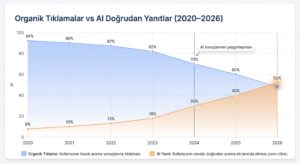
Generative engines, pushing aside the traditional "blue link" listing logic; They have become structures that synthesize information from multiple sources and offer direct and personalized responses to the user. This transformation is not only a ranking challenge for content producers, but also a challenge to be cited as a "reliable source" within these synthesized answers created by artificial intelligence. Productive engines become a final stop that directly meets user intent. This accelerates the “zero-click” phenomenon, which can potentially result in reduced organic traffic to websites. Data for 2025 shows that approximately 25-30% of Google searches will now end directly through artificial intelligence summaries, without clicking on any website. This change necessitates that content strategies change from "click-oriented" to "citation-oriented" structure. to be cited as a synthesized source in answers
Radical Change in the Search Paradigm: Synthesis-Oriented Information Retrieval
While traditional search engines function as traffic distribution centers that direct the user to relevant websites; Productive engines become a final stop that directly meets user intent. This accelerates the “zero-click” phenomenon, which can potentially result in reduced organic traffic to websites. Data for 2025 shows that approximately 25-30% of Google searches will now end directly through artificial intelligence summaries, without clicking on any website. This change requires content strategies to change from "click-oriented" to "citation-oriented".
| Feature | Traditional SEO | Generative Engine Optimization (GEO) |
| Main Goal | To attract traffic by ranking high in SERP | To be cited as a synthesized source in YZ answers |
| Visibility Model | Position-based, linear ranking (1st, 2nd, 3rd place) | Gradual, based on number of words and position within the answer |
| Success Criteria | Click-Through Rate (CTR), Organic Traffic, Conversion | Citation Frequency, Share of Voice, Citation Strength |
| Technical Focus | Crawling Budget, Indexing, Page Speed | Schema Markup, Asset Clarity, Machine Readability |
| Content Strategy | Keyword density and user engagement | Fact density, structured data and expert citations |
| Maturity | Mature and with established standards | Rapidly evolving and shaped by experimental data |
Technical Architecture of Generative Engines and RAG Mechanism
To make sense of GEO strategies, it is first necessary to understand the Search Augmented Generation (RAG) architecture, which is the working principle of these engines. While traditional models only talk about training data, productive search engines perform a real-time search on the web before responding to the user query.
In this architecture, it is not enough for a web page to just be in the index; The page must be included in the list of “most relevant and trustworthy sources” that LLM uses when creating a response. Productive engines; Scores pages based on criteria of semantic clarity, structural organization, and factual density. In particular, systems such as Perplexity and Gemini attach great importance to authority signals in order to prove the accuracy of the information they quote. Working with a professional GEO agency so that your brand does not get lost in this new ecosystem allows you to turn this technical complexity into an advantage.
New Metrics in Visibility Measurement: PAWC and SI
The "average rank" metric in traditional SEO is inadequate in the face of the complex structure of productive engines. A website may constitute a large part of the AI response, or it may only appear as a small reference in a single sentence. Two key metrics stand out for measuring this nuanced visibility: Position-Adjusted Word Count (PAWC) and Subjective Impression (SI).
PAWC metric analyzes the word volume within a source's AI response and where this volume is positioned in the response. Information at the beginning of the answer has a higher weight because it attracts more user attention. Subjective Impression, on the other hand, is a qualitative score that evaluates the relevance of the quote to the query, its reliability, and the likelihood that the user will click on the source. These metrics allow brands to understand how much they are dominating the AI response, not just “whether they are there” or not. Artificial intelligence models prefer content that "reduces uncertainty" and "provides evidence." Do not show
Research-Based GEO Strategies and Performance Gains
Extensive studies have shown that certain modifications to web content can increase generative engine visibility by up to 40%. Artificial intelligence models prefer content that “reduces uncertainty” and “provides evidence.”
| Optimization Method | Visibility Increase (PAWC) | Visibility Increase (SI) | Basic Operation |
| Citation | %30 – 40 | %15 – 30 | Content refers to reliable external sources |
| Inserting Statistics | %40+ | %20+ | Inserting concrete, numerical data into text |
| Direct Quotation | %40 | %25+ | Inserting quoted passages from industry experts |
| Authoritative Language | %15 – 20 | %10+ | Adopting a precise, knowledgeable, and professional tone |
| Technique Terms | %10 – 15 | %5+ | Condensation of domain-specific terminology |
In the light of this data, using the phrase “64% of Fortune 500 companies have integrated this software into their workflows” instead of “many companies use this software” directly makes it easier for the model to quote this information. Optimizing data density using artificial intelligence SEO tools is a critical move in this process.
AgentGEO and SAGEO: Advanced Optimization
The most advanced stage in the GEO discipline is agent-based systems called AgentGEO. While traditional methods apply general rules to all content, AgentGEO uses a “diagnostic and repair” cycle that queries why a particular page is not cited. Research shows that 62.2% of citation failures are caused by "Semantic Alignment" errors, that is, the content not fully meeting the query intent. For a document to be seen by artificial intelligence, it must first pass through traditional search engine filters. Therefore, a successful strategy must balance both traditional SEO criteria (titles, metadata) and GEO criteria (information density, expert opinions).
SAGEO (Search Powered Productive Engine Optimization) considers the process as a whole. For a document to be seen by artificial intelligence, it must first pass through traditional search engine filters. Therefore, a successful strategy must balance both traditional SEO criteria (titles, metadata) and GEO criteria (information density, expert opinions).
Platform-Based Differences: ChatGPT, Gemini, and Perplexity
Each productive engine has a different resource attribution mechanism. It is essential for brands to take a platform-responsive approach:
- Perplexity: Over-reliance on real-time data. The share of data coming from community platforms such as Reddit is as high as 46.7%.
- Gemini: It is extremely selective in its source selection; 99% of their resources come from niche specialty sites. The way to be successful here is to accurately reflect the answer to the question of what is E-E-A-T in your content.
- ChatGPT: It looks at how much of a spoken authority the brand is across the web (sector reports, news) and prefers to weave brands into the text in a natural way.
| Platform | Source Preference | Quote Style | Current Priority |
| Perplexity | Reddit, News, Blogs Numbered inline links Critical (Real Time) | Numbered inline links | Critical (Real Time) |
| Gemini | Niche specialty sites (99%) | Source cards and snippets | High (Index Based) |
| ChatGPT | Common brand authorities | In-text names and links | Medium (Education + Live) |
| Claude | Technical and academic data | Often brand name attribution | Low/Medium |
Entity Orientation and Schema Markup
In the world of productive engines, keyword matching has been replaced by "Entity Clarity". AI systems create a Knowledge Graph by understanding semantic relationships between entities. Schema markup (Schema.org) is the alphabet of this process.
The following schema types are now a necessity for GEO success:
- FAQPage: It is the most powerful tool for artificial intelligence to extract information in question-answer format.
- Article / TechArticle: Expertise signals of the content defines.
- Organization: Verifies the brand's credentials and place in the industry.
- Product: Configures product features and ensures that you are selected in “best alternatives” queries.
Also, presenting the contents in Markdown format (H1, H2, lists) increases the confidence of LLMs in parsing the content and the likelihood of being cited. raises.
2025-2026 Search Trends and User Behavior
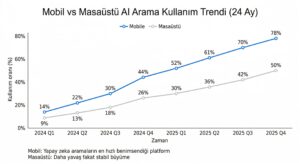
The search ecosystem is now an “assistant” layer rather than a “finding” tool. 70% of users prefer artificial intelligence search tools because they save time. This situation; It has led to the establishment of natural conversations instead of fragmented keywords, and visual and voice searches (such as Google Lens) to exceed 10 billion per month. Users now use an average of 6 different channels to access information.
GEO Implementation and Recovery Plan for Businesses
To gain visibility into AI responses, the following 7-step roadmap should be followed under the guidance of a professional SEO agency The following 7-step road map should be followed under the guidance of:
- Audit and Status Analysis: The “share of voice” of existing content on ChatGPT, Perplexity and Gemini should be measured.
- Technical Base and Schema Integration: Critical pages should be updated with FAQ, Article and Organization schemas.
- Content Condensation: Pages; should be revised with statistics (40% increase) and expert quotes (40% increase).
- Presence and Authority Building: The brand should be mentioned in third-party authorities (Reddit, industry magazines).
- Readability Audit: Contents should be cleared of complexity and have an “Inverted Pyramid 2.0” structure. should be adopted.
- Measurement and GA4 Configuration: Traffic from artificial intelligence sources should be specifically monitored.
- Recovery and Iteration: When visibility drops, the diagnostic-repair cycle should be started with AgentGEO principles.
Generative Engine Optimization (GEO) is a temporary trend of digital marketing It is not, but a natural consequence of the internet's new operating system. Success is no longer measured only by being on the 1st page of Google, but by being an indispensable part of the synthesized response that artificial intelligence offers to the user. Technical competencies from the traditional SEO discipline, combined with GEO's presence and trust-based approaches, will create a sustainable visibility platform for brands. In the digital world of the future, not only those who are clicked, but those who are trusted and cited will win.


